
KLC Oxford International SCHOOL
Scuola Bilingue Paritaria a indirizzo internazionale
NURSERY
PRE-SCHOOL
PRIMARY SCHOOL
ROBOTICS
Clicca qui
DRAMA CLASS
Clicca qui
LOWER SECONDARY
Oxford International Lower Secondary School
Click Here

NURSERY

(from 3 to 36 months)

HOURS:

8.00/13.30

(half day)

8.00/16.00

(full day)

8.00/18.00

(full extended)

PRE-SCHOOL

(from 3 to 6 years)

HOURS:

8.00/16.00

(full day)

8.00/18.00

(full extended)

PRIMARY SCHOOL and LOWER SECONDARY

(from 6 to 14 years)

HOURS:

8.30/15.30

(full day)

8.30/18.00

(full extended)

SUMMER SCHOOL

(from 6 months to 10 years upon availability)
Subscriptions are weekly or monthly

HOURS:

8.00/16.00

(full day)

8.00/18.00

(full extended)

Download our new training offer below

International School Campus on the Appian Way, Rome

The KLC International School Campus is situated in the prestigious Ardeatino / Appia Antica North area, overlooking the Appian Way Archaeological and Regional Park, the largest protected urban park in Europe. This unique location in Rome is easily accessible from the Ardeatino, Appio-Latino, Garbatella, Ostiense, Eur, and Grottaperdetta districts, making it ideal for families seeking a school immersed in greenery without sacrificing city access.

The campus extends over 2,000 sqm of indoor space and 4,000 sqm of outdoor areas, and is organised across three modern school buildings housing the nursery, kindergarten, primary school, and lower secondary school. Facilities include a fully equipped gym, an outdoor multi-purpose sports field, an internal canteen, teaching laboratories and ateliers, dedicated consultation rooms for specialists in childhood and parenting, and extensive outdoor play areas. Private and municipal parking is also available for families.

KLC International School is a secular and state-recognised private school, approved by the Italian Ministry of Education, offering an international education in Rome through the Oxford International Curriculum. The educational approach focuses on the holistic development of each student, enhancing socio-emotional, cognitive, and relational skills, and is built on a model that combines academic excellence, wellbeing, and pedagogical innovation.

Bilingual Curriculum, International Assessments, and Global Competences

The Curriculum Offer (PTOF) at KLC International School is structured as a bilingual Italian–English pathway, designed to ensure academic progression, personalised learning, and solid educational foundations. The integration of the Italian Ministry of Education programme with the Oxford International Curriculum enables our students to develop measurable, internationally recognised skills, expanding opportunities for mobility and continuity throughout their educational journey.

English-language instruction is delivered through CLIL methodology, the use of Oxford teaching materials, and the implementation of Oxford Assessment, which allow for objective and continuous monitoring of students’ linguistic and cultural progress, ensuring high standards of quality and transparency. Additionally, the programme can be tailored to prepare students for Trinity College London and Cambridge English examinations, providing formal recognition of their communication and language proficiency.

The curriculum is further enriched by interdisciplinary projects and an active, hands-on learning approach. The S.T.E.A.M. methodology fosters scientific, logical, and creative thinking, while the Life Skills programme strengthens personal, social, and emotional competencies, essential for balanced and conscious growth.

Through this educational model, KLC International School nurtures competent, autonomous, and responsible students, fully equipped to thrive in international educational settings and to face the challenges of a rapidly evolving global society.

The psycho-educational methodology devised by Dr. Perla Boccaccini (Through Children’s Competencies – Ed. Bookness 2023), head teacher at the KLC School, is used at an interdisciplinary level, embracing the whole school. Its key elements are:

BILINGUALISM

A Bilingual Journey of Excellence from the Earliest Years

Our bilingual programme introduces English from early childhood, in line with the recommendations of the European Commission, which recognise the value of early language exposure for children’s cognitive, emotional, and social development.

Oxford International Curriculum

The educational pathway integrates the Oxford International Curriculum with the Italian curriculum, offering a modern, international, and scientifically structured learning experience. Through Oxford materials and methodologies, children acquire English naturally, progressively, and authentically, developing essential linguistic and global competencies.

Qualified Teachers and International Certifications

The bilingual programme is led by highly qualified native and bilingual teachers, holding international certifications for teaching English to children (CELTA, TEFL, and Early Years specialisations).

Throughout the programme, the school issues:

  • Progress reports and certificates, documenting each student’s linguistic and personal development

  • Oxford International school-based curriculum completion certificates

  • Standardised Oxford assessments, with benchmarks and progressive evaluations aligned with international standards

The school is a Registered Trinity College Examination Centre and Cambridge Preparation Centre, enabling students, when ready, to take official internationally recognised English language exams, in accordance with the CEFR – Common European Framework of Reference for Languages.

International Class: Learning Through English

In International Classes, English is not just a subject but the language of learning. Activities and lessons are delivered in English through an immersive, CLIL-based approach, in line with the Oxford International Curriculum.
Children are at the centre of the learning process, with teachers guiding and facilitating – focusing on the learning journey, not just the outcome.

An Inclusive, Future-Oriented Environment

Innovative, inclusive, and multicultural classes foster autonomy, critical thinking, creativity, and international openness, preparing children to approach the world of tomorrow with confidence and curiosity.

The subjects that enrich the school curriculum

Robotics and Coding: Competing in the Future

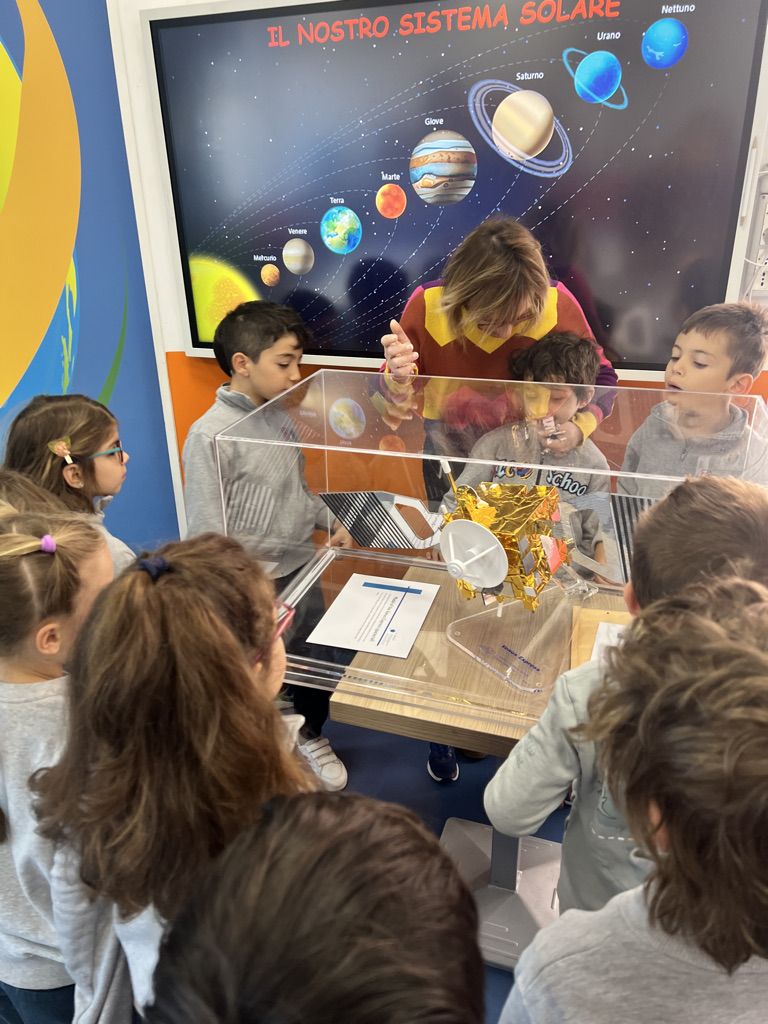
We prepare our students for a rapidly evolving world, developing technological and transversal skills from primary school onwards.

Key objectives:

  • 🚀 Technology and Programming – learn to design and program robots and digital systems

  • 🧠 Critical Thinking and Problem Solving – tackle challenges with creativity and logical reasoning

  • 🤝 Collaboration and Teamwork – work together to design and innovate

  • 🌍 STEM Readiness – acquire skills for careers in science, technology, engineering, and mathematics, preparing for a world increasingly driven by automation

From the classroom to practical applications: learning through play and hands-on experience, developing tangible skills that are applicable in the future.


DRAMA CLASS: Discover Theatre in English

A creative and engaging programme where students explore the world of theatre and acting in English, developing talent, confidence, and collaboration.

Key objectives:

  • 🎭 Acting and Performance – enhance vocal skills, body language, and stage presence

  • 🧩 Creativity and Improvisation – explore emotions, characters, and storytelling

  • 🤝 Teamwork and Social Skills – collaborate to create and perform productions

  • 🌟 Self-Confidence and Communication – express oneself confidently while developing effective communication skills

A comprehensive theatrical experience, where learning means taking risks, expressing oneself, and growing both as an individual and as part of a community.

MUSICAL EDUCATION

Music education is included in our curriculum because it has multiple benefits that go beyond simply learning musical instruments or music theory:

Here are some key points on the importance of including music education in the school curriculum:

Development of cognitive skills. Scientific studies have shown that learning music is related to the development of cognitive skills such as critical thinking, memory, concentration and problem-solving. Students who study music tend to perform better in other subjects, such as mathematics and science.

Expression and creativity: Music is an important form of artistic expression that allows students to express emotions, thoughts and ideas in a unique and personal way. This stimulates children’s creativity and imagination, encouraging them to think in innovative and original ways.

Development of social skills: Music often involves teamwork and collaboration, encouraging students to communicate, listen and respect the opinions of others. These social skills are fundamental to the personal and professional success of individuals in later life.

Promoting emotional well-being: Music has the power to influence our emotional state. Studying and performing music can be an activity that helps pupils manage stress, anxiety and other emotional problems, thus improving their well-being.

MASTERCLASS

Each year, Masterclasses are held at our school that enrich our students’ educational experience by providing them with the opportunity to learn from industry experts, to be inspired, to make professional connections and to develop practical and soft skills that are crucial to their future.

BENEFITS

  • Knowledge expansion. By having professionals selected for their strong skills and experience to share, we offer a broader and deeper perspective on a given topic or sector.
  • Inspiration and motivation. Interacting with industry experts can inspire pupils and motivate them to pursue their own interests and ambitions. Seeing the success and experience of masterclass guests can encourage them to pursue their own passions and aspirations.
  • Practical approach to learning. Masterclasses often include hands-on activities and demonstrations; this practical approach to learning helps students better understand the concepts and practical applications of what they are learning.

Extracurricular activities

It is possible to attend numerous after-school activities:
FOOTBALL, THEATRE, DANCE, MUSIC, TENNIS, BASKETBALL
(as well as numerous other POTENTIAL activities).

Ask for your appointment 


    Contact

    Address

    Browse the dedicated website

    About Us

    Do you want to know our teaching method?
    Visit our blog!